 blog
blog
Professional Concrete Patio Repair Services: 2026 Guide
Table of Contents
- Signs Your Patio Needs Professional Concrete Patio Repair
- Concrete Patio Repair vs Replacement: Which Makes Sense?
- What Affects Concrete Patio Resurfacing Cost in 2026
- Choosing the Best Concrete Crack Filler for Patios
- How Professional Concrete Patio Repair Services Fix Common Damage
- Matching New Repairs to Existing Concrete Color and Texture
- Long-Term Maintenance That Protects Your Patio Investment
- Frequently Asked Questions
Last Updated: September 12, 2026
Signs Your Patio Needs Professional Concrete Patio Repair
Professional concrete patio repair addresses damage beyond cosmetic wear, and acting early saves more of the original slab.
Concrete patio repair restores a damaged slab's surface, structure, or level position rather than demolishing and repouring it. The right approach depends on which of those three has failed.
Here's what actually signals that repair is the smarter call:
- Hairline cracks wider than a credit card. Narrow shrinkage lines are normal. Cracks you can slide a coin into are not.
- Spalling. Flaking, pitted surfaces where the top layer has popped off, often after a freeze-thaw cycle.
- Sunken walkways or settled slab sections. A trip hazard and a drainage problem in one.
- Rebar corrosion stains. Rust-colored streaks mean moisture has reached the steel, and the problem is structural.
What most guides miss: two or three of these together usually point to one root cause, soil movement under the slab. Tulsa's clay soil expands when wet and shrinks when dry, working on concrete all year.
Concrete Patio Repair vs Replacement: Which Makes Sense?
Repair wins when the base is stable and damage covers less than roughly a third of the surface. Replacement wins when the concrete is crumbling throughout, the base has failed, or you're changing the patio's footprint. You can answer the deciding questions yourself before calling anyone:
| Situation | Better Option | Why |
|---|---|---|
| Isolated cracks, stable slab | Repair | Structural integrity is intact |
| Widespread spalling or crumbling | Replace | Surface has failed across the slab |
| One sunken section | Repair with leveling | Base can be stabilized |
| Multiple settled areas plus drainage issues | Replace | Underlying base has failed |
| Color or texture mismatch after a repair | Resurfacing | Blends old and new visually |
If the damage is localized, a targeted repair restores function at a fraction of the disruption. If the whole slab is failing, repair becomes a series of patches that never quite hold. Any contractor who skips that trade-off is selling you something.
What Affects Concrete Patio Resurfacing Cost in 2026
Concrete patio resurfacing cost depends on square footage, damage severity, surface preparation, and finish. Pricing varies too widely by region, slab condition, and materials for any responsible contractor to quote a flat number over the phone.
The variables that move the number most:
- Square footage. The single biggest factor. Larger slabs cost more in both material and labor.
- Damage severity. Hairline cracks and a simple overlay cost far less than structural repair plus resurfacing.
- Surface preparation. Grinding, cleaning, and crack filling are labor hours that have to happen before any coating goes down.
- Finish selection. A basic broom finish and a stamped, colored overlay are not in the same price bracket.
- Access. A backyard patio with a narrow gate takes longer to work than a driveway.
Ask any provider to itemize preparation, material, and finishing separately, a vague single-line estimate tells you nothing.
Choosing the Best Concrete Crack Filler for Patios
The best concrete crack filler for patios depends on crack width, orientation, and whether the slab is still moving. No single product handles every situation. Before buying anything, measure the crack and watch it for a season.
Step 1: Measure the crack width
Use a crack gauge, feeler gauges, or a credit card as a rough reference, a credit card is about 1/32 inch thick, a quarter about 3/32 inch (usmint.gov). Width drives product choice more than anything else:
- Hairline (under 1/16 inch). Cosmetic. A thin, self-leveling sealant or a penetrating sealer is usually enough to keep water out.
- Narrow (1/16 to 1/4 inch). The standard repair range. Most pourable sealants and polyurethane injectables are designed for this window.
- Wide (over 1/4 inch). Needs a backer rod or sand to limit depth, then a flexible sealant. A wide crack is also a sign the slab has moved, so filler alone is a temporary fix.
Step 2: Decide if the slab is still moving
This step determines whether a repair lasts one season or ten. Check the same crack in late summer and early spring. If the width changes measurably, the slab is moving and rigid filler will crack open again.
- Stable slab, structural crack. Epoxy injection. It bonds the two sides rigidly and restores load-bearing capacity. Epoxy is strong but brittle, so it belongs only in concrete that has stopped moving.
- Moving slab, active crack. Polyurethane foam injection. The foam expands to fill the void and stays flexible, so seasonal movement does not tear it open again.
- Horizontal crack or expansion joint. Self-leveling polyurethane sealant. It flows into the gap and cures into a flexible, water-resistant seal that accommodates movement.
Step 3: Match the product to the location
A patio crack differs from a driveway crack: patios see foot traffic, furniture, and standing water, but rarely vehicle loads. That changes the priority:
- Expansion joints and control joints. These are supposed to be open. Fill them with a flexible sealant, never a rigid patch, so the slab can still move.
- Cracks near the patio edge. Often caused by soil washing out under the slab. Sealing the crack without addressing drainage traps the symptom.
- Cracks that crisscross or form a map pattern. Usually a sign of a failing base or a bad original mix. Filler will not fix the underlying problem.
Step 4: Know when filler is the wrong tool
A common mistake is grabbing caulk-style filler for a crack that is actively widening, that fix lasts one season. If the crack changes width with the weather, the slab is moving, and flexible injection is the only repair that holds. If it's wider than a quarter inch, sounds hollow when tapped, or the slab has settled more than about half an inch, filler is a bandage, the slab needs leveling or structural repair first.
DIY vs. professional: a quick decision guide
Most homeowners can handle a hairline crack in a stable slab with a $15 tube of sealant and an afternoon. It stops being DIY when:
- The crack is wider than 1/4 inch.
- The crack width changes with the season.
- The slab has settled, tilted, or become a trip hazard.
- You can see rust stains from rebar corrosion.
- Water pools near the crack after rain.
If any are true, the crack is a symptom, not the problem. A professional assessment will tell you whether the fix is injection, leveling, or partial replacement, usually free or credited toward the work.
How Professional Concrete Patio Repair Services Fix Common Damage
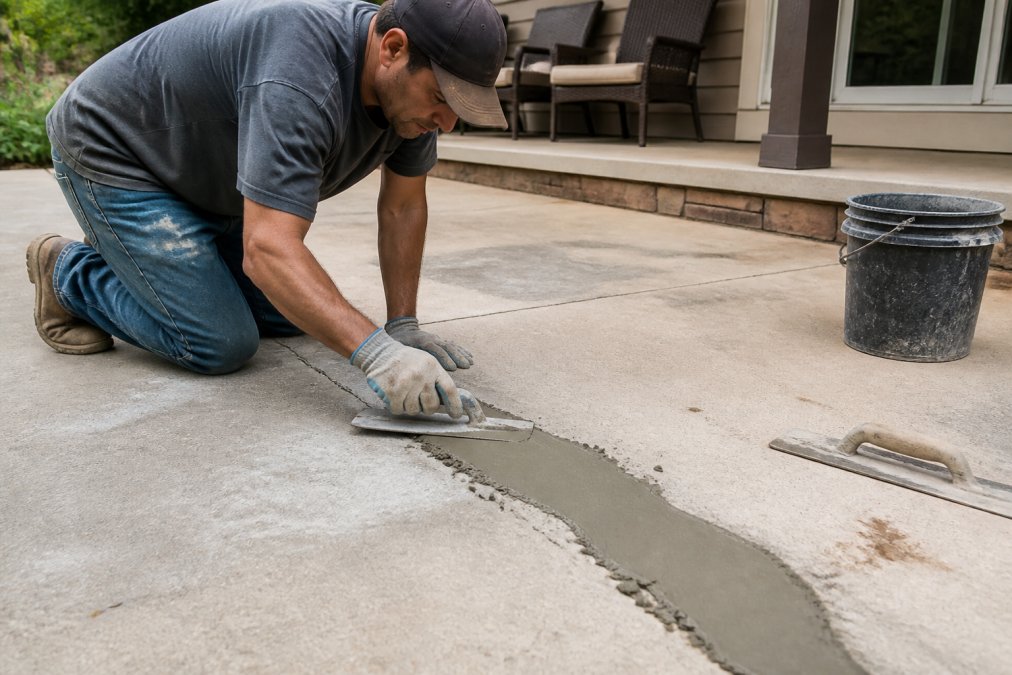
Professional concrete patio repair services follow a sequence: evaluate the slab, prepare the surface, repair the structure, then restore the finish. Skipping any stage shortens the repair's life, which is why preparation eats so many labor hours.
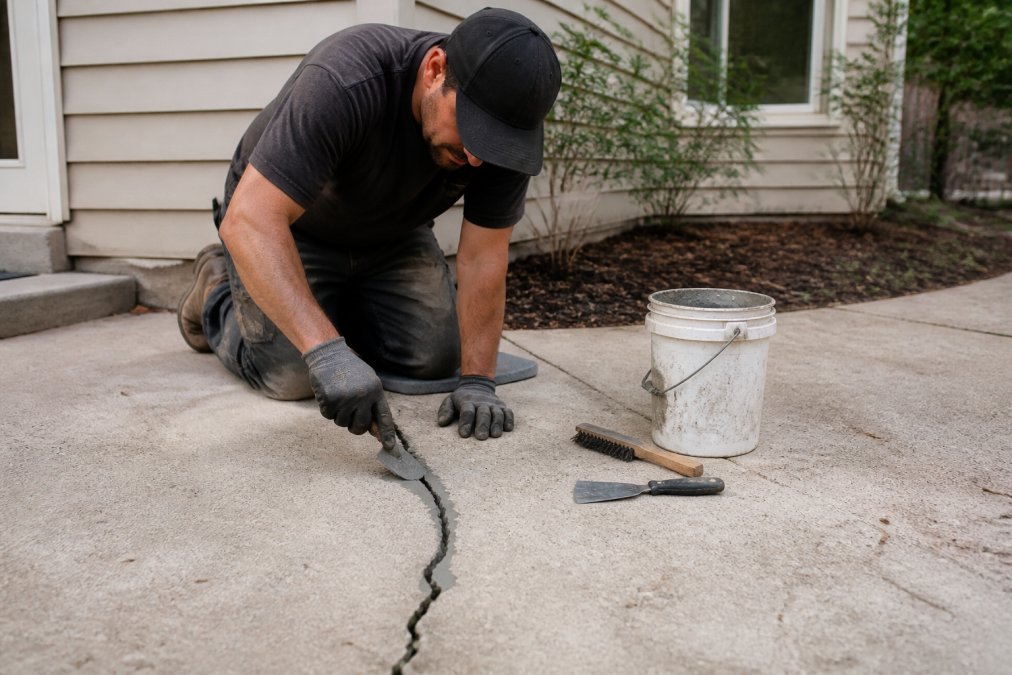
The evaluation stage separates good work from fast work: a contractor should tap for hollow spots, look for drainage issues feeding water under the slab, and confirm whether damage is cosmetic or structural.
Preparation comes next. Cracks get cleaned and widened slightly so filler can bond, loose material is removed, and the surface is ground or etched so the overlay can grip.
Structural repair follows: settled sections get leveled by lifting the slab or stabilizing the base, and cracks get injected. Only then does resurfacing happen, bonding agents, overlay or topping, then texture and color work that makes the repair disappear.
Matching New Repairs to Existing Concrete Color and Texture
Color and texture matching is the difference between a repair and a visible patch. Test a sample area before committing to the whole surface, because concrete cures darker or lighter depending on moisture, aggregate, and application method.
Three things drive whether a repair blends:
- Aggregate selection. The sand and stone in the mix determine the base tone. A mismatched aggregate reads as a different material.
- Trowel finish and texture. A smooth trowel finish next to a broom finish is obvious from across the yard.
- Curing and moisture. New concrete cures lighter than it looks when wet. Matching to the wet color guarantees a mismatch.
The practical approach: a test patch in an inconspicuous spot, cured fully, then compared to the existing slab in daylight. Adjust the mix, repeat, then do the visible work. It costs an extra day and saves the entire job. A repair that functions but doesn't match is one you'll notice every time you walk outside.
Long-Term Maintenance That Protects Your Patio Investment
Maintenance separates a repair that lasts a decade from one that lasts three years. The routine takes an afternoon or two per year, but timing matters as much as the tasks. In a climate with freeze-thaw cycles and expansive clay soil, a calendar that follows the annual stress cycle catches problems before they become repairs.
A seasonal maintenance calendar
Spring (after the last freeze)
- Walk the slab and mark new cracks with chalk, comparing against last year's marks to see which are growing.
- Tap with a screwdriver handle; a hollow sound means the top layer has separated from the slab.
- Clean packed expansion joints so the slab can move.
- Look for rust-colored stains, moisture has reached the rebar, and the problem is structural.
Summer (dry season)
- Measure cracks marked in spring; if measurably wider now, the slab is moving and rigid filler will fail.
- Check drainage, water should flow away from the patio edge, not pool against it. A $10 bag of soil or $30 downspout extension often prevents a $2,000 leveling job.
- Re-seal small cracks while they're small; a hairline crack becomes a wide one after a winter.
Fall (before the first freeze)
- Apply a penetrating sealer if it's been two to three years; it keeps water out and slows the freeze-thaw damage that causes spalling.
- Clear leaves and debris from expansion joints and downspout bases near the patio.
- Fill any crack wider than a credit card, water that freezes inside will widen it by spring.
Winter
- Avoid de-icing salts, which accelerate surface breakdown on newer slabs; use sand or calcium magnesium acetate for traction (cement.org).
- Don't chip ice with a metal tool, you'll take the top layer of concrete with it.
- After a freeze-thaw cycle, check visually for new spalling or popped flakes.
The tasks that actually matter, ranked
If you only do three things all year, do these:
- Seal every two to three years. A penetrating sealer is the single highest-return maintenance task for a concrete patio.
- Keep expansion joints clean. Debris in the joints transfers stress into the slab instead of letting it move.
- Fix drainage before it becomes a slab problem. Water pooling near the patio edge is the leading cause of settling.
What to skip
- Pressure washing at high settings. It can erode the surface paste and expose aggregate, especially on a broom finish. Use a fan tip on a low setting, or a garden hose and a stiff brush.
- Sealing a slab that has already settled. Sealing over a slab that has settled traps the symptom, not the cause. The crack returns within a season, and you have paid twice.
- Painting over spalling. Paint does not stop spalling. It hides it for one season and makes the eventual repair harder.
For commercial properties, the same calendar applies at a larger scale, and catching cracks early keeps a parking lot from becoming a full repour. A patio and a parking lot fail for the same reasons, water, movement, and time, and the same maintenance prevents both.
Frequently Asked Questions
How much does professional concrete patio repair cost?
Pricing depends on the type and extent of damage, patio size, and whether resurfacing or leveling is needed. Small crack repairs cost far less than full slab replacement. GatorCrete provides a free estimate with a written scope before work begins, so you know the number upfront. Request a quote for your specific patio.
Is professional concrete repair worth it compared to DIY?
DIY crack filler works for hairline cracks under 1/8 inch. Beyond that, structural issues like settling, spalling, or rebar corrosion need professional assessment. A contractor can identify the root cause, use epoxy injection or polyurethane foam leveling, and apply bonding agents correctly. DIY fixes on structural damage often fail within a season.
Can a cracked concrete patio be repaired or does it need replacement?
Most cracked patios can be repaired. Hairline cracks, spalling, and settled slabs respond well to patching, resurfacing, and concrete leveling. Replacement makes sense when more than 30% of the slab is damaged or when the base has failed. A contractor can assess structural integrity and recommend the right path.
How long does a professional concrete patio repair last?
A properly repaired patio lasts 10 to 20 years with regular sealing every 2 to 3 years. Longevity depends on soil movement, drainage, and whether the original cause of damage was fixed. In areas with clay soil, expansion joints and moisture barriers help prevent recurring cracks. Sealing protects against freeze-thaw damage and hydrostatic pressure.
Concrete damage rarely improves on its own, and the repair that costs the least is always the one done before the slab fails completely. GatorCrete brings GATOR TOUGH craftsmanship, transparent communication, and high-quality materials to every repair, from a single cracked patio to full commercial restoration. Get a quote from GatorCrete and find out what your patio actually needs before you spend on a replacement.