 ultimate-guide
ADA Compliant Concrete Parking Lot Repair: 2026 Guide
Table of Contents
- What ADA Compliance Means for Concrete Parking Lot Repair
- ADA Parking Space Slope Requirements Every Lot Must Meet
- Common ADA Parking Lot Violations and How Repairs Fix Them
- Commercial Concrete Slab Leveling for Sloped or Settled Parking Areas
- ADA Parking Lot Violation Penalties and Property Manager Liability
- Permits, Inspections, and Repair vs. Replacement Decisions
- Maintenance Checklist to Keep Your Lot Compliant Year-Round
- Conclusion
- Frequently Asked Questions
Last Updated: September 15, 2026
What ADA Compliance Means for Concrete Parking Lot Repair
ADA compliant concrete parking lot repair restores accessible parking spaces, access aisles, and connecting routes to meet federal standards for dimensions, slope, and surface condition. At GatorCrete, we treat compliance as an engineering requirement, not a cosmetic touch-up.
The rules come from the 2010 ADA Standards for Accessible Design, which the U.S. Department of Justice ADA Standards enforces alongside local building codes. A repair that fixes a pothole but leaves a 1:40 cross slope on the access aisle fails inspection. That distinction drives every scope we write.
Most guides treat ADA work as striping and signage, but the concrete underneath decides whether you pass or fail.
ADA Parking Space Slope Requirements Every Lot Must Meet
ADA parking space slope requirements cap running slope at 1:48 and cross slope at 1:48 for accessible spaces and access aisles. That works out to roughly a 2% grade in any direction, measured on the finished surface.
Why so tight? A person using a wheelchair self-propels across that surface. A grade that feels trivial underfoot becomes a steering problem under wheels, and a slope that pushes a chair toward traffic is a genuine safety hazard.
The measurement method matters as much as the number. Slope is checked with a digital level at multiple points, not eyeballed at the center, because settled slabs, root heave, and patched edges create localized deviations a single reading misses.
Three field conditions cause most slope failures:
- Settlement pockets where subgrade soil has consolidated unevenly
- Root intrusion lifting one corner of a slab
- Drainage regrading that tilted a section toward a new drain inlet
Each calls for a different fix: grinding works on a high spot but does nothing for a low one.
Access Board guidance on accessible parking notes that slope is measured on the surface as built, not as designed. What's on the drawing doesn't matter if the pour settled.
Common ADA Parking Lot Violations and How Repairs Fix Them
The violations we see most often are faded or missing pavement markings, absent or damaged truncated domes, cracked access aisles, and signage mounted too low or blocked by vegetation. Each has a repair path.
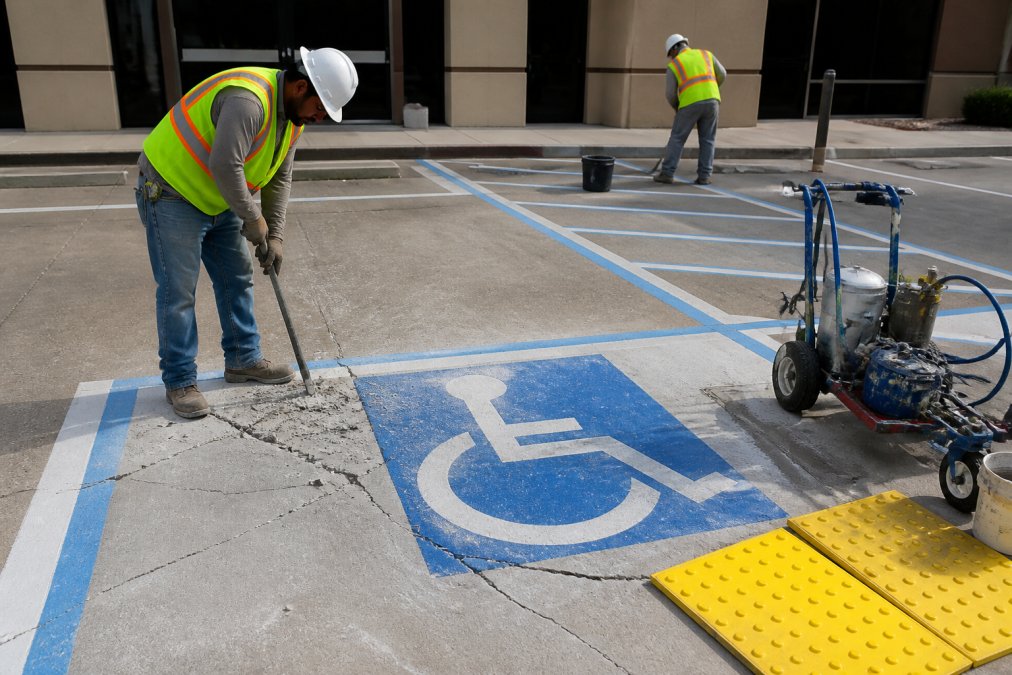
Here's the practical breakdown:
| Violation | Typical Cause | Repair Approach |
|---|---|---|
| Faded pavement markings | UV exposure, traffic wear | Re-stripe with slip-resistant traffic paint |
| Missing truncated domes | Impact damage, adhesive failure | Replace tactile warning surfaces at curb ramps |
| Cracked access aisle | Subgrade failure, freeze-thaw | Remove and repour the affected panel |
| Non-compliant signage | Wrong height, obscured | Remount at correct height, clear sightlines |
| Ponding water | Poor drainage grade | Level slab or add drainage correction |
These failures cluster: a cracked access aisle usually means the subgrade has already moved, so the slope is drifting too. Fix the crack alone and you'll be back in eighteen months.
Access Aisles, Van-Accessible Spaces, and Signage
An access aisle is the striped area beside an accessible parking space that lets a person deploy a wheelchair lift or ramp. Van-accessible spaces require a wider aisle and signage identifying them as van-accessible.
Three details inspectors check first:
- Aisle width and markings. The aisle must be striped and kept clear. Parked carts, dumpsters, and snow piles are violations.
- Vertical clearance. Van-accessible spaces and the routes serving them need adequate overhead clearance for a raised lift or roof-mounted equipment. Tree limbs and low signs cause failures here.
- Sign placement. Signs must be mounted high enough to be visible over a parked vehicle and positioned so they aren't blocked.
Treating the access aisle as overflow parking during busy periods turns a compliant lot into a non-compliant one overnight.
Commercial Concrete Slab Leveling for Sloped or Settled Parking Areas
Commercial concrete slab leveling corrects a slab that has settled or tilted out of tolerance without a full tear-out. For ADA parking, it's often the difference between a targeted repair and replacing an entire section, and between a weekend of downtime and a month.
Two methods dominate the market, and they work on completely different principles.
Mudjacking (slurry injection). A crew drills 1- to 2-inch holes a few feet apart and pumps a cementitious slurry of water, sand, Portland cement, and sometimes bentonite or fly ash beneath the slab. The slurry fills voids, hydraulic pressure lifts the slab back toward grade, and the holes are patched with matching concrete.
Polyurethane foam injection. A two-part polyurethane resin is injected through smaller holes, often 5/8 inch, where it expands on contact with soil moisture, filling voids and lifting the slab. The foam cures in 15 to 30 minutes and is significantly lighter than slurry.
Here's how the two compare on the factors that actually drive the decision:
| Factor | Mudjacking | Polyurethane Foam |
|---|---|---|
| Typical hole size | 1-2 in. | 5/8 in. |
| Cure / return to service | Often same day, but slurry must set | 15-30 min for the foam; often same day |
| Added load on subgrade | High (slurry is heavy) | Low (foam is lightweight) |
| Lift range | Moderate | Precise, small lifts |
| Soil tolerance | Needs reasonably stable soil | Tolerates weaker, wetter soils better |
| Relative cost | Generally lower per point | Generally higher per point |
| Best fit | Larger voids, deeper lifts, cost-sensitive scopes | Tight ADA tolerances, weak soil, fast turnaround |
The choice depends on soil conditions and how much lift you need. Foam suits tighter tolerances and faster turnaround, the precision a 1:48 cross slope demands. Slurry costs less per point but adds load and cures slower, which matters if the subgrade is already marginal.
A detail most guides skip: the drilling pattern is part of the engineering. Holes placed too far apart leave unsupported spans, and the slab can re-settle along those lines within a season or two. Ask how the contractor lays out injection points and whether they verify lift with a digital level as they go.
Where leveling falls short: if the slab is badly fractured or the subgrade has failed across a wide area, lifting just moves the problem. Removal and replacement is the honest answer, and a contractor who says otherwise is selling you a second repair.
ADA Parking Lot Violation Penalties and Property Manager Liability
ADA parking lot violation penalties typically surface through civil litigation rather than a fixed fine. The Department of Justice can pursue enforcement, and private plaintiffs can bring ADA claims. Property managers and owners carry the exposure.
That's what catches people off guard: no routine inspector writes tickets for a faded access aisle. The risk arrives as a complaint, demand letter, or lawsuit after someone is injured or blocked.
The ADA.gov complaint process allows individuals to file complaints directly, and the legal overview of ADA Title III obligations covers how those claims apply to places of public accommodation.
For a property manager, the practical exposure includes:
- Legal fees regardless of outcome
- Court-ordered remediation on a deadline you don't control
- Damages in injury cases tied to a non-compliant surface
- Reputational cost with tenants and customers
Documented maintenance is your best defense. A log showing regular inspections and prompt repairs demonstrates good-faith effort. A lot with no records and a cracked access aisle tells a very different story.
Permits, Inspections, and Repair vs. Replacement Decisions
Most commercial parking lot repairs require a permit, and the inspection that follows is where good intentions meet the code.
Maintenance Checklist to Keep Your Lot Compliant Year-Round
Use this checklist:
Conclusion
Frequently Asked Questions
What are the specific slope requirements for ADA accessible parking spaces?
Accessible parking spaces and access aisles can't slope more than 1:48 (about 2.08%) in any direction, which is roughly a half-inch of rise per two feet. Ramps serving the space can run up to 1:12. These slope requirements exist so wheelchairs and mobility devices don't roll or require excessive effort. If your lot has settled or heaved past those numbers, commercial concrete slab leveling or targeted replacement is usually the fix.
Does a parking lot repair trigger a requirement to bring the entire lot up to ADA standards?
Not always. The 2010 ADA Standards require that alterations to a parking facility, when it's relatively easy to do, bring the altered area and its path of travel into compliance. A small pothole patch may not trigger a full retrofit, but resurfacing or reconfiguring spaces often does. State and local building codes can be stricter than the federal rule, so confirm requirements with your local building department before scoping work.
What are the most common ADA violations found in concrete parking lots?
The five most frequently cited issues are missing or faded pavement markings, slopes that exceed 1:48 on spaces and access aisles, deteriorated curb ramps or missing truncated domes, insufficient van-accessible spaces, and signs mounted too low or missing the required verbiage. Concrete spalling and cracked surfaces around spaces also trigger violations because they break the accessible route. An ADA audit or site survey catches these before a complaint does.
How often should commercial parking lots be inspected for ADA compliance?
There's no federal inspection schedule, but most property managers should do a visual walkthrough quarterly and a formal ADA audit every 12 to 24 months. After any concrete repair, restriping, or sealcoating, re-inspect the affected spaces before reopening them. Tulsa-area freeze-thaw cycles and clay soil movement accelerate cracking and settling, so lots here often need closer attention than the national average.