 how-to
Commercial Concrete Slab Leveling: How It Works
Table of Contents
- What Is Commercial Concrete Slab Leveling?
- Polyurethane Foam Concrete Lifting vs. Mudjacking
- Concrete Slab Stabilization Methods for Commercial Properties
- How the Commercial Concrete Leveling Process Works
- Commercial Concrete Repair Cost: What Affects the Price
- Why Choose Polyurethane Foam for Commercial Slabs?
- Preventative Maintenance and Long-Term Care
- Conclusion
- Frequently Asked Questions
Last Updated: September 10, 2026
What Is Commercial Concrete Slab Leveling?
Commercial concrete slab leveling is the process of raising and re-supporting a settled or sunken concrete slab by injecting material beneath it, rather than demolishing and replacing the slab. For property managers and business owners, it is the difference between a weekend of downtime and a month of lost parking.
The repair itself is straightforward. Knowing when to call for it is where most owners lose money.
Signs Your Concrete Slab Needs Leveling
The clearest sign is a visible height difference between adjacent slabs, typically a quarter inch or more (ada.gov). Watch for these indicators:
- Pooling water that lingers 24 hours after rain
- Cracks wider than a credit card at slab edges
- A rocking or hollow sound when vehicles cross a joint
- Doors, gates, or dock levelers that no longer sit flush
- Trip hazards flagged during a ADA accessibility compliance review
Catch these early and you're looking at a targeted injection. Ignore them and you're looking at replacement.
Polyurethane Foam Concrete Lifting vs. Mudjacking
Polyurethane foam concrete lifting and mudjacking both raise a settled slab, but they work nothing alike. Mudjacking pumps a cement-and-soil slurry under the slab. Polyurethane injection pumps an expanding two-part foam that cures in minutes and weighs a fraction as much.
| Factor | Polyurethane Foam | Mudjacking |
|---|---|---|
| Material weight | Very light | Heavy slurry |
| Cure time | Minutes | Hours to days |
| Hole size | Pencil-sized | Larger drilled ports |
| Water resistance | Hydrophobic | Absorbs moisture |
| Best for | Commercial slabs, void filling | Simple residential slabs |
The weight difference matters on commercial sites. A heavy slurry adds load to already-compromised soil; expanding foam lifts without adding stress to the sub-base.
How Polyurethane Foam Injection Works
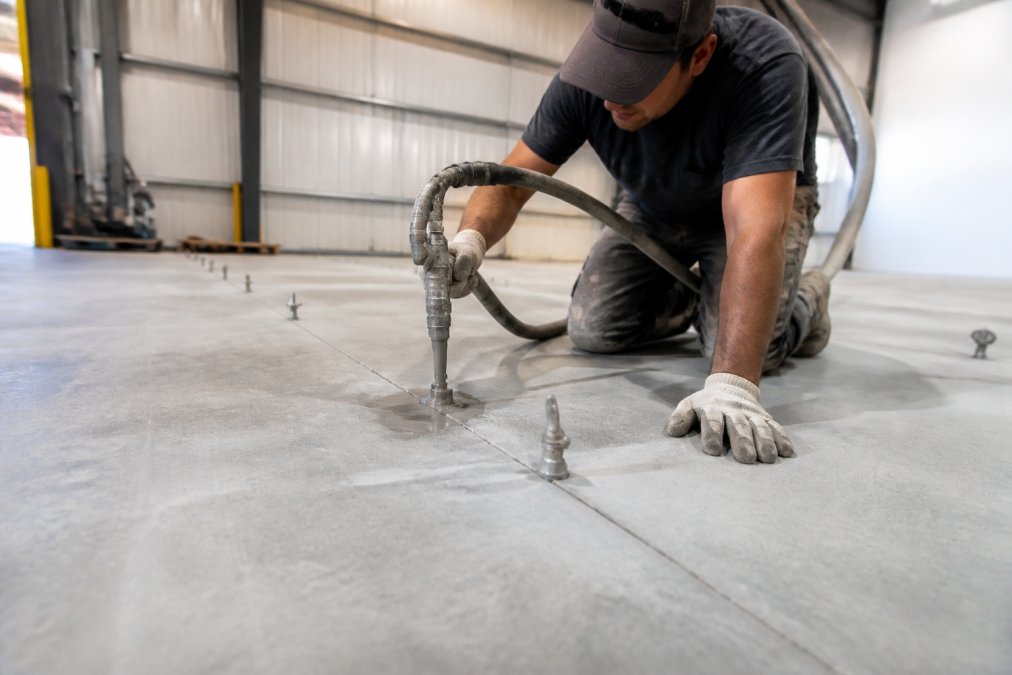
The contractor drills small ports through the slab, then injects high-density foam that expands and fills voids while lifting the slab to grade. Because the material is hydrophobic, it doesn't reabsorb groundwater the way a slurry can.
Concrete Slab Stabilization Methods for Commercial Properties
Concrete slab stabilization methods fall into three broad categories, and choosing the wrong one is the most expensive mistake a property manager can make. The categories are injection lifting, void grouting, and structural underpinning. Each addresses a different failure mode, and the failure mode, not the size of the dip, determines which one is correct.
Injection lifting raises a settled slab back to grade by pumping material into the void beneath it. The slab is intact and the soil under it has compressed, eroded, or shifted. This is the right answer for the majority of parking lots, drive lanes, dumpster pads, and warehouse aprons.
Void grouting fills empty space under a slab without deliberately lifting it. It is used when the slab is still at grade but the sub-base has washed out, a common condition near downspouts, storm inlets, and irrigation lines. Left alone, a void becomes a settlement, because the slab is now spanning air instead of soil.
Structural underpinning transfers load to deeper, more competent soil using piers or piles. It addresses deep foundation failure, not a surface slab that has dropped. Underpinning is the correct call when the movement is tied to the building foundation, when settlement is ongoing and deep, or when a retaining structure is failing.
A common mistake is jumping straight to underpinning when the real problem is a void under a single panel. That is an expensive answer to a cheap question, and it does nothing for the drainage that created the void in the first place.
Matching the Method to the Failure
| What you observe | Likely failure mode | Typical method |
|---|---|---|
| One or two panels dropped at a joint | Localized soil compression or erosion | Injection lifting |
| Slab at grade but hollow-sounding | Sub-base washout, no lift needed yet | Void grouting |
| Movement continuing after repair | Deep soil or foundation issue | Geotechnical review, then underpinning |
| Slab dropped near a downspout or inlet | Water-driven erosion | Drainage correction plus injection lifting |
| Wide cracking across many panels | Expansive soil cycling | Soil stabilization plan plus injection lifting |
Why Diagnosis Comes Before Method
In this region, expansive clay soil is the usual driver. It swells when wet and shrinks when dry, and that cycle pumps a slab up and down until the sub-base can no longer hold it. A contractor who quotes a method before identifying that cycle is treating a symptom.
The diagnostic questions that matter are simple: Where does water go after a rain? Is the movement isolated to one panel or spread across several? Is the slab still at grade, or has it actually dropped? The answers point to the method. The method never points to the answers.
The Commercial Stakes
On a commercial site, the method choice also drives downtime. Injection lifting and void grouting are same-day or overnight procedures. Underpinning is a multi-week construction project with excavation, equipment staging, and blocked access. That gap in schedule, not the gap in unit price, is usually what decides the method for an operating facility.
How the Commercial Concrete Leveling Process Works
A commercial concrete slab leveling project moves through three phases: diagnosis, injection, and finish. Skipping the diagnosis phase is how slabs get "fixed" twice.
Step 1: Site Inspection and Soil Analysis
A proper site inspection maps every settled panel, checks drainage, and reviews the soil conditions causing the movement.
Step 2: Injection and Void Filling
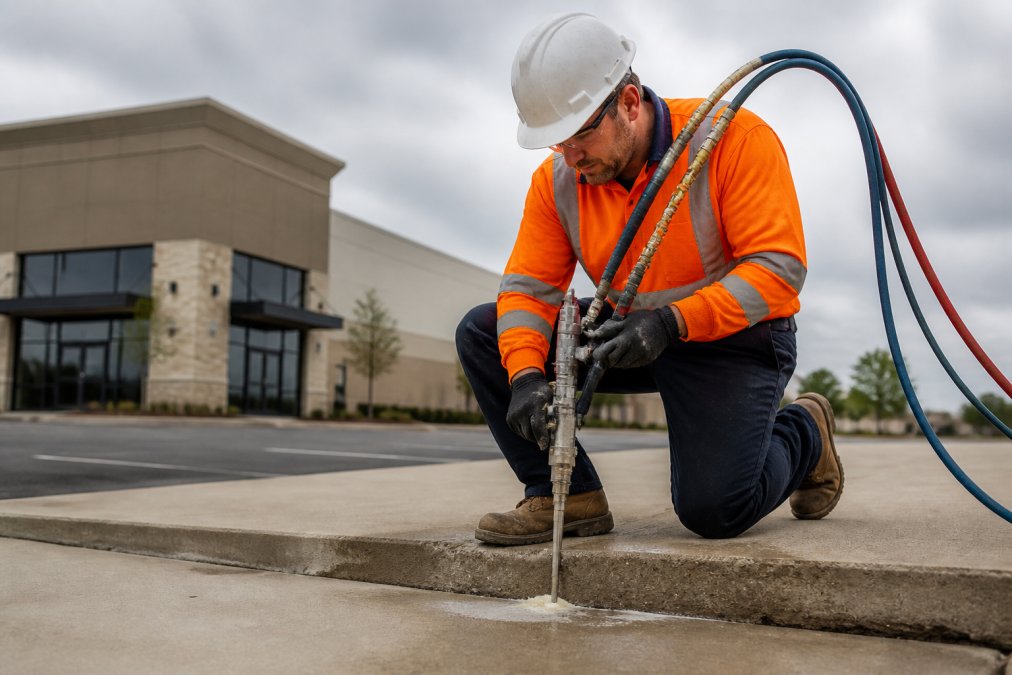
The crew drills small ports, injects foam from the lowest point outward, and monitors lift in real time. Void filling happens alongside lifting, so the slab ends up supported across its full footprint rather than balanced on a single high point.
Step 3: Finishing and Curing
Ports are patched, joints are cleaned, and the surface is checked against grade. Curing time for the foam itself is quick, which is why most commercial slabs can return to service the same day. That same-day return is the single biggest reason business owners choose injection over replacement.
Commercial Concrete Repair Cost: What Affects the Price
Commercial concrete repair cost depends on square footage, how far the slab has settled, access for equipment, and whether drainage needs correcting. There is no honest flat rate, and any contractor who quotes one before walking the site is guessing.
But for a commercial property, the invoice is only part of the number. The real cost of a settled slab is the invoice plus the cost of the disruption used to fix it. A repair that closes a drive lane for a week can cost more in lost traffic, delayed deliveries, and tenant complaints than the injection work itself. That is why the smartest commercial buyers evaluate bids on total cost of ownership, not unit price.
The Four Variables That Move the Number
- Slab area, more panels means more injection ports, more material, and more labor hours. Pricing scales with the number of lift points, not just square footage.
- Settlement depth, a slab that has dropped an inch needs far less material than one that has dropped four. Deeper drops also take longer to lift in controlled stages.
- Soil conditions, expansive clay may require a stabilization plan in addition to lifting, and a void that has washed out under a panel needs more fill than a simple lift.
- Access and downtime, overnight, weekend, or phased work changes scheduling and labor cost. A site that can only be worked in short windows costs more to service than one that can be closed for a day.
The Cost Competitors Don't Quote: Downtime
This is the gap most pricing pages skip. For an operating facility, the schedule is the price.
- Same-day return to service. Polyurethane injection cures in minutes, so most commercial slabs can be reopened the same day. That is the single biggest reason business owners choose injection over replacement.
- Phased panel-by-panel work. A parking lot does not have to close all at once. Crews can lift one section, reopen it, and move to the next, keeping traffic flowing.
- Off-hours scheduling. Overnight and weekend windows eliminate customer-facing disruption entirely, at a labor premium that is usually far smaller than a day of lost revenue.
- No demolition, no dumpsters. Injection lifting avoids the tear-out, haul-off, and re-pour cycle that replacement requires, which removes days from the schedule and debris from the site.
When you compare a replacement bid to a leveling bid, put both on a calendar. The one that returns the asset to service faster is usually the cheaper one, even when its line-item price is higher.
What a Written Estimate Should Include
A written, itemized estimate is your protection. Before you sign anything, the Federal Trade Commission's guidance on home improvement contracts is worth reading. A commercial-grade estimate should spell out:
- The number of injection ports and the material to be used
- Whether drainage correction is included or excluded
- The work schedule and expected return-to-service time
- What happens if the slab does not lift as predicted
- The warranty terms in writing
Getting a Straight Answer
For a straight answer on your property, the contractor needs to walk the site, map the settled panels, and identify the water path. That inspection is what turns a range into a real number, and it is the only way to compare two bids honestly.
Why Choose Polyurethane Foam for Commercial Slabs?
Polyurethane foam wins on commercial slabs because it's light, fast, and water-resistant. The material won't add load to failing soil, it cures fast enough to avoid multi-day shutdowns, and it doesn't absorb moisture the way cement slurry does.
For a business, downtime is the real cost. A parking lot closed for a week costs more in lost traffic than the repair itself. Foam injection typically lets you reopen the same day.
Preventative Maintenance and Long-Term Care
Preventative maintenance is what separates a slab that lasts decades from one you're re-leveling every few years. The goal is simple: keep water away from the sub-base and catch small movement before it becomes a trip hazard.
- Seal cracks as they appear, before water reaches the sub-base
- Keep gutters and drainage swales clear year-round
- Re-seal joints and control joints on a regular schedule
- Inspect after freeze-thaw cycles and heavy rain
- Schedule a professional site inspection annually
A maintenance plan costs far less than repeat repairs. That's the case for every commercial property in this region.
Conclusion
Settled concrete is a maintenance problem, not a demolition problem, and treating it that way saves both money and downtime. GatorCrete provides professional concrete services for both residential and commercial clients throughout the Greater Tulsa area. By combining precision craftsmanship with high-quality materials, the team delivers durable, GATOR TOUGH results that transform spaces into enduring statements of strength and style. Whether you need new installations, expert repairs, or protective sealing, GatorCrete is committed to transparency, communication, and exceeding your project expectations. Get a quote from GatorCrete and put your parking lot, walkways, and slabs back on solid ground.
Frequently Asked Questions
How much does commercial concrete slab leveling cost?
The cost of commercial concrete slab leveling depends on the size of the area, the extent of the damage, and the specific method used. Polyurethane foam injection typically costs more per square foot than mudjacking but offers faster curing and less downtime. For an accurate estimate, contact a professional like GatorCrete for a site inspection and a detailed quote.
Is polyurethane foam better than mudjacking for commercial slabs?
Polyurethane foam concrete lifting is often preferred for commercial slabs because it is lightweight, cures quickly, and is hydrophobic, meaning it won't wash away with water. Mudjacking uses a cement slurry that is heavier and takes longer to cure. The best choice depends on your specific soil conditions and load requirements; a professional can help you decide.
How long does a commercial concrete leveling project take?
Most commercial concrete leveling projects can be completed in a few hours to a couple of days, depending on the size of the area and the method used. Polyurethane foam injection allows for rapid return to service, often within 30 minutes of injection, minimizing downtime for your business.
What are the signs that a commercial slab needs leveling?
Common signs include uneven surfaces, cracks, trip hazards, water pooling, and doors or windows that stick. If you notice these issues, it's best to have a professional inspect the slab. Addressing problems early can prevent further damage and extend the life of your concrete.